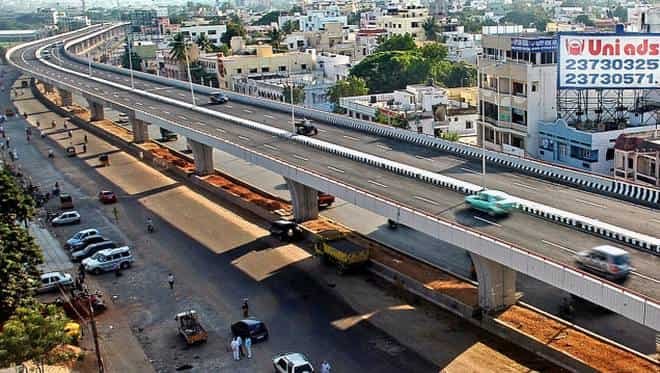
Named after a former Prime Minister who once represented this very city, the PV Narasimha Rao Expressway has quietly become the backbone of South Hyderabad’s road network — the stretch that decides whether your trip to the airport, to Mehdipatnam, or through Attapur takes twenty minutes or an hour. Locals just call it PVNR, and if you’ve driven anywhere between Khairatabad and Shivrampally, you’ve almost certainly used a piece of it without necessarily knowing where it starts or ends. Here’s the layout, mapped out properly.
Quick Overview
| Aspect | Details |
| Location | Runs through Khairatabad, Mehdipatnam, Attapur, Aramghar, Shivrampally |
| Nearest metro | Khairatabad (Red Line), 3-minute walk from one end |
| Key bus hub | Mehdipatnam Bus Station |
| Nearby district | Ranga Reddy |
| Nearby landmarks | Sarojini Devi Eye Hospital, Amba Theatre, A.G. College |
| Public transport options | TGSRTC buses, Hyderabad Metro, MMTS trains, autos, cabs |
Why This Expressway Carries So Much of South Hyderabad’s Traffic
PVNR Expressway connects the city centre area around Khairatabad with the southern outskirts running through Mehdipatnam, Attapur, Aramghar, and Shivrampally, before feeding into the broader NH-44 network. That NH-44 connection matters more than it sounds — it’s the direct route to the airport, to major IT hubs, and to destinations across the state, which is why residential projects as far as Rajendra Nagar list proximity to PVNR as a genuine selling point.
Attapur, one of the localities this expressway runs through, sits under GHMC administration in Ranga Reddy district and functions as a working commercial and residential belt precisely because PVNR gives it fast access both into the city and out toward the highway network. The expressway effectively does double duty — local commuter road for residents along its length, and a genuine bypass for anyone heading toward the airport or interstate destinations.
Getting Onto PVNR Expressway by Road
From Khairatabad: This marks one end of the expressway, with the metro station sitting just 225 metres away — a 3-minute walk if you’re combining rail and road travel.
From Mehdipatnam: The bus station here sits close enough to double as an entry point onto PVNR, making this a natural starting point for anyone travelling south from central Hyderabad.
From Attapur or Aramghar: These localities run directly along the expressway’s length, so local roads feed straight onto PVNR without much of a detour.
Toward the airport: Once on PVNR heading south, the road connects into NH-44, cutting travel time to Rajiv Gandhi International Airport considerably compared to navigating through city-centre traffic instead.
Given how much through-traffic uses this stretch specifically to bypass central Hyderabad, expect it to move faster than city roads most of the day — though Mehdipatnam and Aramghar junctions still see real slowdowns during standard office hours.
Metro and Rail Connectivity Near PVNR
Khairatabad Metro Station on the Red Line sits right at one end of the expressway, just a 3-minute walk away, giving commuters a genuine option to combine rail travel with a short road stretch rather than driving the entire distance. For those closer to the southern end, Shivrampally Metro Station is roughly 6.5 km from localities like Rajendra Nagar, connecting onward to Ameerpet, HITEC City, and Secunderabad.
MMTS suburban trains also run parallel to sections of this corridor, with services stopping near Shivrampally and Aramghar — a lesser-known but genuinely useful option for residents in these southern pockets who’d rather skip the road entirely.
Nearby Landmarks Worth Knowing
- Sarojini Devi Eye Hospital — A well-known healthcare landmark near Khairatabad, roughly 9 minutes on foot from the expressway.
- Amba Theatre — A recognizable local reference point close to Mehdipatnam.
- G. College — An educational institution sitting near the Aramghar stretch of the expressway.
- Mehdipatnam Corner — A busy commercial junction functioning as an informal landmark for directions in this area.
- Attapur — A significant residential and commercial locality running along a large portion of PVNR’s length.
Bus Stops and Local Transport Options
TGSRTC buses serve this corridor extensively, with routes 300, 300L, 251, 252, 532, and 537 among those running along or near PVNR. Aramghar functions as one of the busier boarding points, just a 2-minute walk from the expressway itself, while Mehdipatnam Bus Station serves as the larger hub for anyone connecting from central Hyderabad.
For last-mile travel along the localities PVNR passes through — Attapur, Aramghar, Shivrampally — autos remain the standard choice, given how spread out residential pockets are relative to the main expressway itself.
Best Time to Travel on PVNR Expressway
Morning and evening office-hour traffic bunches up hardest near the Mehdipatnam and Aramghar junctions, where local roads feed into the expressway and create genuine bottlenecks even though the main stretch itself moves reasonably well. If your trip is time-sensitive — catching a flight, for instance — building in extra buffer specifically for these junction points, rather than the expressway itself, tends to be the smarter call.
FAQs
Q1. Does PVNR Expressway connect directly to the airport?
Yes — heading south from Khairatabad, the expressway feeds into NH-44, which runs directly toward Rajiv Gandhi International Airport, cutting out most of the city-centre traffic you’d otherwise face.
Q2. Which metro station is closest to PVNR Expressway?
Khairatabad, just a 3-minute walk from one end of the expressway, though Shivrampally Metro Station serves the southern stretch for residents closer to Rajendra Nagar and Attapur.
Q3. Is Mehdipatnam Bus Station a good starting point for reaching PVNR?
Yes — it sits close enough to function as a natural entry point, and it’s well served by TGSRTC routes coming from across central Hyderabad.
Q4. Why do Mehdipatnam and Aramghar see more congestion than the rest of PVNR?
These junctions handle the bulk of local traffic merging onto the expressway from surrounding residential and commercial areas, creating bottlenecks even though the main stretch of PVNR itself generally moves faster than typical city roads.

